

By Jax Stys, certified life coach
Quick answer: To lower monthly debt payments and free up cash flow, look at what each debt costs you per month, not just its balance or rate. Pay off the debts with the biggest monthly payment for their size first. That frees up cash fastest and lowers your debt-to-income ratio (DTI), which lenders check when you apply for a home or rental loan.
Update: I did it. The car is paid off. More on that below.
I’m Jax, a certified life coach for women over 40. I’ve worked in mortgage lending for 20-plus years, and as of October 2026, I’ve paid off $45,000 in debt.
When I started my new job in June 2026, the raise was the first real breathing room I’d had in years. It would have been easy to spend it on a fancy new wardrobe.
I didn’t. Instead, I sat down with every bill I had and asked a different question than I usually do: which of these is squeezing my month the most?
Two things changed at once. I started a new job with a higher income, and I reactivated my real estate license.
My big goal is to buy a second rental property using an investor loan and hold it in an LLC. After 20-plus years in mortgage lending, I know what a lender looks at first: how much of your monthly income already goes to debt payments. I needed that number lower.
Your debt-to-income ratio (DTI) is all your monthly debt payments divided by your gross monthly income. Gross means before taxes. That’s the definition from the Consumer Financial Protection Bureau (CFPB).
Here’s the CFPB’s example. Say you pay $1,500 for a mortgage, $100 for a car loan, and $400 for other debts. That’s $2,000 a month. If you earn $6,000 a month before taxes, your DTI is about 33%.
Different lenders and loan types have different DTI limits. So if you’re planning to apply for a loan, ask the lender what they look for.
Try this: Add up your monthly debt payments. Divide by your monthly income before taxes. Write the number down.
Nothing, for a lot of people. Both can work. The CFPB describes both: the Debt Snowball pays the smallest balance first for quick wins, and the Debt Avalanche pays the highest interest rate first to save on interest.
But neither one looks at your monthly cash flow or your debt-to-income ratio. You could spend two years paying down one big card, and your minimum payment barely changes until it hits zero. Meanwhile your DTI stays high and your budget stays tight.
If you want to qualify for a home, a rental property, or a business loan, that matters a lot.
Pay off the debts that take the biggest monthly bite for their size. Here’s what that cash flow thinking looks like.
Say you have five bills:
Look at Bill B and Bill C. Bill C has a smaller balance but a much bigger monthly payment. Paying it off frees up $525 every month. Paying off the larger Bill B would take more money and free up less.
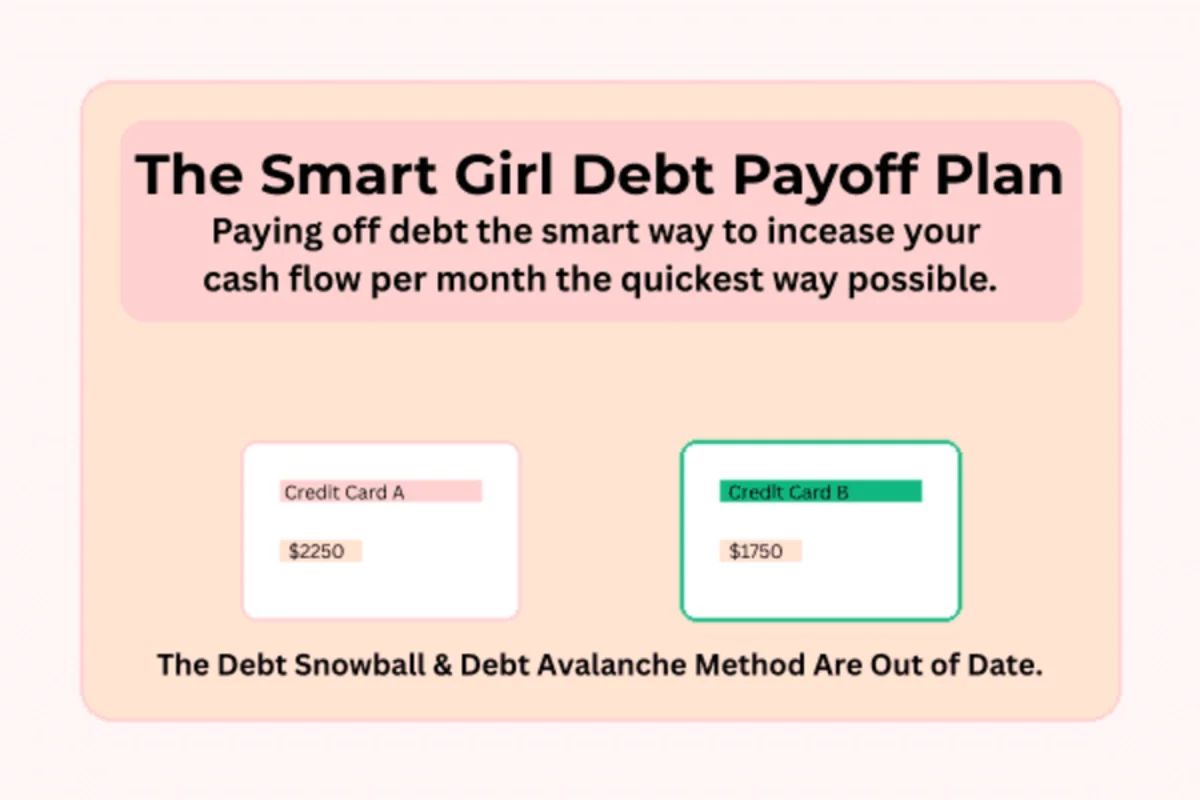
That’s the idea behind The Smart Girl Debt Payoff Plan. In the guide, I share the formula I use to rate each debt by how much stress it puts on your monthly budget, so you know where to send extra money first.
I had a vehicle loan with about $11,000 left and a $525 monthly payment. It had the lowest rating in my system. I also had four credit cards eating about $500 a month in minimums.
My plan in June 2026 was to use part of my savings to pay off the car and those four cards by mid-July. That frees up about $1,025 a month.
The car part is done. The extra cash each month goes to savings, everyday expenses, and the rest of my cards. My goal is zero credit card debt by spring 2027. I’m not there yet.
Let’s keep it real: Using savings to pay off debt isn’t right for everyone. Think about your own emergency fund first.
If you want the bigger picture, here’s how I paid off my first $32K of debt as a single mom. And if you’re rebuilding from scratch, start with how to start over financially after 40.
The full Smart Girl Debt Payoff Plan has the formula, the rating system, and a worksheet to figure out your own payoff order. It’s $9.99.
It’s all your monthly debt payments divided by your monthly income before taxes. Lenders use it to decide if you can take on a new loan, like a mortgage. For example, $2,000 in monthly debt payments on a $6,000 monthly income is a DTI of about 33%.
Paying off a debt with a large monthly payment frees up cash right away and lowers your DTI faster. Paying down a big balance may not lower your payment until it’s fully paid off.
No. Both can work. The Snowball pays the smallest balance first, and the Avalanche pays the highest interest rate first. They just don’t look at monthly cash flow or DTI, which matter if you plan to apply for a loan soon.
It depends on your situation. Paying off a debt with savings can free up cash every month, but it also shrinks your safety net. Make sure you’d still have an emergency fund for surprise bills first.
Pull up your bills.
Look at the monthly payments, not just the balances.
Pick the one that’s squeezing you most.
That one decision can give you real breathing room.
If you want help looking at your whole life, not just your money, take the free Glow Assessment.
With love and confidence,
Jax
This post shares my personal experience and is for education only. It is not financial advice. I’m a coach and educator, not a financial advisor.